
The Three-Part System Behind Every Crypto Payment: Wallet, Blockchain, Consensus
You've decided to accept Bitcoin from a client, or you're sending USDC to a contractor in Lisbon instead of wiring through SWIFT. You hit send. Then you wait — and somewhere between that click and the recipient seeing funds, a sequence of cryptographic, network, and consensus events unfolds that most senders never bother to understand until something breaks. A stuck transaction. A wrong-network send. A fee surprise that doubles your settlement cost.
Understanding how crypto payments work isn't optional once you're moving real money — it's the difference between a settled transaction and funds stranded on the wrong chain. By the end of this walkthrough, you'll understand the three-component system that powers every payment, the seven-stage transaction lifecycle, why confirmation times vary wildly across networks, what makes a payment irreversible, when crypto is the right tool versus a worse one, and a verification checklist you can run before every send.
This is the operational view, not the marketing pitch. No "future of money" framing. Just the mechanics, the trade-offs, and the decisions you actually face as someone moving funds on-chain.

Table of Contents
- The Three-Part System Behind Every Crypto Payment
- Your Payment Journey: The Seven Stages Between Click and Confirmation
- Why Confirmation Speed Varies Across Networks
- Private Keys, Signatures, and Why Irreversibility Is Your Responsibility
- When Crypto Payments Make Sense — And When They're the Wrong Tool
- The Pre-Send and Post-Send Verification Checklist
The Three-Part System Behind Every Crypto Payment: Wallet, Blockchain, Consensus
Every crypto payment involves three distinct components working together, and most confusion about how do crypto payments work comes from conflating them. Treat them separately and the rest of the system becomes legible.
The Wallet: Software, Not Storage
The most common misconception is that a wallet stores coins. It does not. A wallet stores private keys and constructs and signs transactions on your behalf. The "balance" you see on screen is the wallet querying the blockchain for unspent outputs tied to your public address (Bitcoin's UTXO model) or for current account state (Ethereum's account model). The coins live on the network. The wallet just holds the authority to move them.
This distinction matters operationally. Self-custody wallets like MetaMask, Ledger, and Trezor put the private key on your device — you sign, you broadcast, you bear the risk and the control. Custodial accounts at exchanges like Coinbase, Kraken, and Binance hold keys on your behalf, meaning the exchange — not you — controls signing authority. According to Kraken's custody documentation, custodial services manage keys, security infrastructure, and transaction processing for clients who choose not to manage their own.
During a payment, the wallet's job is mechanical: build the transaction (recipient address, amount, fee), sign it with your private key, and broadcast the signed transaction to network nodes for propagation.
The Blockchain: A Shared Ledger of Ownership Records
The blockchain doesn't track "coins" as objects. Bitcoin tracks UTXOs — references to prior transaction outputs you have authority to spend. Ethereum tracks account balances as state. Both systems produce the same outcome from the user's perspective (you see a balance, you spend it), but the underlying data model is different, and that difference shows up in fee calculations and transaction construction.
Every full node on the network keeps an identical copy of this ledger. When your transaction is added to a block, every node updates its copy. The original concept traces to Satoshi Nakamoto's Bitcoin whitepaper (2008), which described a peer-to-peer electronic cash system where ownership is established through a public chain of digital signatures.
The operational implication: the blockchain is the source of truth, not your wallet's display. If the blockchain doesn't show your transaction, it didn't happen — regardless of what your wallet shows.
Consensus: The Agreement That a Payment Is Valid
Consensus is how thousands of independent nodes agree your transaction is legitimate without a central authority approving it. The mechanism varies by network.
Bitcoin uses Proof of Work (PoW): miners compete to solve a cryptographic puzzle, and whoever wins adds the next block and earns the block reward plus transaction fees. Ethereum, post-Merge (September 2022), uses Proof of Stake (PoS): validators stake ETH and are selected pseudorandomly to propose and attest to blocks. The Ethereum Foundation's consensus documentation walks through both models in detail.
Consensus is what makes a payment final. Until enough nodes have confirmed the block containing your transaction, the payment is pending — not settled. This is why "confirmation count" matters and why exchanges require different confirmation depths before crediting deposits.
How They Work Together in a Single Payment
In sequence: your wallet builds and signs the transaction, broadcasts it to the network, nodes validate the signature and structure, miners or validators include it in a block, consensus confirms the block, the blockchain ledger updates across all nodes, and the recipient's wallet — querying the blockchain — displays the received balance as spendable. Three components. One coordinated motion.
A crypto wallet does not hold your money. It holds the authority to move it — and that distinction is the difference between owning your funds and renting access to them.
Your Payment Journey: The Seven Stages Between Click and Confirmation
Let's walk a single Bitcoin payment from interface to finality. Each stage is observable on a block explorer, and understanding what happens at each one tells you exactly where to look when something stalls.
1. Constructing the transaction. You enter the recipient address, the amount, and a fee tier (typically low, medium, or high; advanced wallets let you specify sat/vB on Bitcoin or gwei on Ethereum). The wallet identifies which UTXOs to draw from (Bitcoin) or which account balance to debit (Ethereum), and assembles the raw transaction data. Nothing has touched the network yet.
2. Signing with your private key. The wallet uses your private key to produce a cryptographic signature — ECDSA on Bitcoin, ECDSA or EdDSA on Ethereum — proving you authorized this specific transaction with this specific recipient and amount. The private key never leaves your device. The Bitcoin Developer Guide documents the signing and serialization process. The signature is what the network will verify against your public address.
3. Broadcasting to the mempool. Your wallet sends the signed transaction to its connected nodes, which propagate it across the network peer-to-peer. It enters the mempool — the memory pool where unconfirmed transactions wait to be picked up. At any given moment, Bitcoin's mempool can hold anywhere from a few thousand to several hundred thousand transactions depending on demand. You can observe live counts at mempool.space.
4. Miner or validator selection. Miners (Bitcoin) or validators (Ethereum) select transactions from the mempool to include in the next block. They almost always prioritize higher fees, because fees are direct revenue. If your fee is below market, you wait. If it's well above, you jump the queue.
5. First confirmation (1 block). When a block containing your transaction is added to the chain, you have one confirmation. Bitcoin targets a ~10-minute average block time through its difficulty adjustment, documented at Bitcoin.org. Ethereum produces a block every ~12 seconds post-Merge per the Ethereum block documentation. One confirmation means your transaction is on the chain — but not yet deeply buried.
6. Confirmation depth. Each subsequent block adds another confirmation. The Bitcoin community convention of 6 confirmations for high-value finality traces directly to Section 11 of the Nakamoto whitepaper, which calculated the probability of a successful double-spend attack at varying block depths. At six blocks, the computational cost of reorganizing the chain to reverse the transaction becomes economically prohibitive. For low-value retail payments, 1–2 confirmations is typical. Exchanges commonly require 3–6 before crediting deposits.
7. Recipient sees spendable balance. The recipient's wallet, querying the blockchain, displays the incoming amount as confirmed and spendable. Until this point, the funds may show as pending or not appear at all, depending on the wallet's display policy.
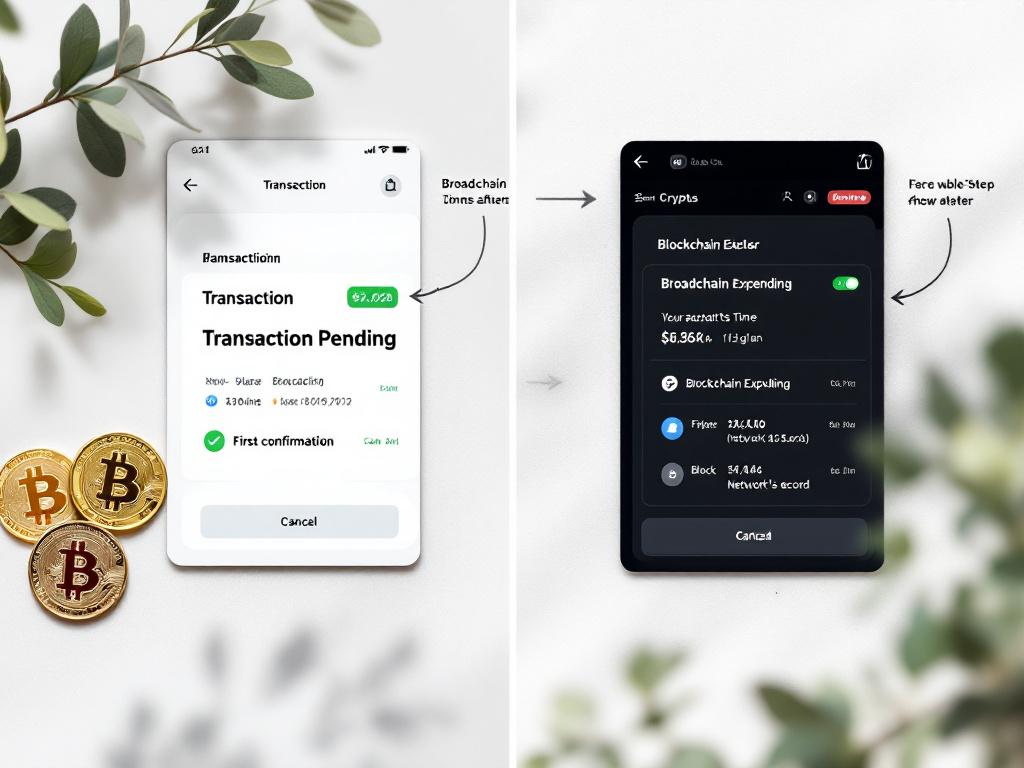

What this sequence reveals: the wallet and the blockchain are different systems. Your wallet can show "sent" while the network has rejected, dropped, or stalled the transaction. The block explorer is the authoritative view. Always.
Why Confirmation Speed Varies Across Networks (And What Actually Controls It)
Speed is not a feature of "crypto." It's a property of each specific network's design choices, plus current congestion. Networks make explicit trade-offs between speed, decentralization, and security — what Vitalik Buterin frames as the blockchain trilemma. Faster confirmation usually means a smaller validator set, higher hardware requirements, or weaker finality guarantees.
Here's how the major networks compare across the criteria that actually matter when you're choosing a rail.
| Network | Block Time | Typical Fee Range | Best Use |
|---|---|---|---|
| Bitcoin (mainchain) | ~10 min | $1–15 (low) to $30+ (high) | Large-value settlement |
| Bitcoin Lightning | <1 sec | <$0.01 | Retail / micropayments |
| Ethereum (mainchain) | ~12 sec | $1–30 (variable gas) | Smart contract payments |
| Polygon (L2) | ~2 sec | <$0.05 | Recurring stablecoin |
| Arbitrum (L2) | ~250 ms | <$0.50 | DeFi & stablecoin payments |
| Solana | ~400 ms | <$0.01 | High-throughput payments |
Sources: Bitcoin.org, Ethereum.org, Lightning Network BOLTs, Polygon documentation, Arbitrum documentation, Solana documentation.
Why Bitcoin's 10 Minutes Is Intentional, Not a Bug
Bitcoin adjusts mining difficulty every 2,016 blocks (roughly every two weeks) to maintain a ~10-minute average block time regardless of how much hashrate joins or leaves the network. This is documented in Bitcoin's protocol overview. Faster blocks would increase the orphan rate (blocks discovered nearly simultaneously and discarded), reduce propagation efficiency, and weaken the security model. Ten minutes is a deliberate compromise — slow enough to give the global node network time to agree, fast enough to be useful.
Ethereum's Gas Market Creates Variable Speed
Post-EIP-1559 (August 2021), Ethereum splits transaction fees into a base fee that adjusts each block based on network demand and a priority tip that goes to validators. During high demand, the base fee rises and low-fee transactions stall in the mempool until conditions ease. This is why two identical transactions sent an hour apart can settle in 12 seconds or 12 minutes — it depends on what else is competing for block space.
Why Solana Feels Instant — and the Trade-off
Solana's ~400ms block time and high throughput rely on a smaller validator set with significant hardware requirements. The network has experienced multiple multi-hour outages, including incidents documented in Solana's status history. Speed comes at a decentralization cost, and that cost is operational risk: if the network halts, your payment doesn't settle until it restarts.
When "Fast Enough" Is a Real Question
A coffee purchase needs sub-second finality — Lightning or Solana fits. A $250,000 B2B settlement does not. Waiting 60 minutes for six Bitcoin confirmations is acceptable when the alternative is a two-day SWIFT wire with intermediary fees. Match the network to the use case, not the other way around. The instinct to default to "fastest available" is what drives bad rail decisions: speed you don't need at security trade-offs you didn't price.
You're not paying for speed — you're paying for priority in a shared queue. A $0.50 transaction can clear in seconds when the network is quiet and hang for hours when it's not.
Private Keys, Signatures, and Why Irreversibility Is Your Responsibility
The cryptography behind crypto payments is well-studied and stable. The operational consequences for the person sending money are not always obvious. Here are the five points that matter most when you're the one signing.
- What a private key actually does. A private key is a 256-bit number that signs transactions using elliptic curve cryptography — specifically the secp256k1 curve on Bitcoin and Ethereum. It does not "unlock" coins. It produces a signature proving the transaction was authorized by the holder of that key. The blockchain verifies the signature against the corresponding public key (your address) and accepts or rejects accordingly. The standard is documented in NIST FIPS 186-5, the federal Digital Signature Standard.
- Why the blockchain doesn't know who you are. Addresses are derived from public keys through cryptographic hashing — no identity is attached at the protocol level. The blockchain sees that signature X is valid for address Y; it has no concept of "you." This is why crypto is pseudonymous, not anonymous. Chain analysis firms like Chainalysis and Elliptic build entire businesses by linking on-chain patterns to real-world identities through exchange KYC data, IP correlation, and clustering heuristics.
- Why payments cannot be reversed. No central authority exists to issue a chargeback. Once a transaction has sufficient confirmations, reversing it would require rewriting blockchain history — which on Bitcoin would require an attacker controlling more than 50% of network hashrate, an economically prohibitive condition. The U.S. Federal Reserve's 2022 research note on stablecoins (FEDS Notes, December 2022) documents this irreversibility as a defining property distinguishing crypto rails from card networks.
- What happens if you lose your key. The funds are unrecoverable. There is no recovery process, no support line, no password reset. Reporting in The New York Times (Popper, 2021) cited Chainalysis estimates that approximately 20% of all Bitcoin in existence sits in wallets with lost or forgotten keys — at peak prices, tens of billions of dollars permanently inaccessible. The cryptography that protects you also imprisons you when you fail your own custody.
- Why exchanges are custodians, not wallets. When you "hold" Bitcoin on Coinbase or Kraken, the exchange holds the private key. Your account is an IOU. This was the operational lesson of the FTX collapse in November 2022, where customer funds were inaccessible because the custodian — not the customer — controlled the keys. The SEC's complaint details how customer assets were commingled and misallocated. "Not your keys, not your coins" is not a slogan. It's a statement about who has the actual authority to sign.
Crypto transactions are irreversible not because the technology is hard to undo, but because no one has the authority to do it. You are the final arbiter of your money.
When Crypto Payments Make Sense — And When They're the Wrong Tool
Crypto is a payment rail, not a payment philosophy. Every rail — ACH, SEPA, SWIFT, card networks, Lightning, stablecoin on L2 — has scenarios where it dominates and scenarios where it adds friction without benefit. The work is matching rail to scenario.
| Scenario | Best Rail | Typical Time | Typical Cost |
|---|---|---|---|
| International B2B ($10K–100K) | USDC on Ethereum L1 or via on/off-ramp | 2–15 min | $1–20 + ramp spread |
| Recurring B2B subscription (cross-border) | Stablecoin on Polygon or Arbitrum | <30 sec | <$0.50 per transfer |
| High-value settlement (>$100K) | Bitcoin mainchain, 3–6 confirmations | 30–60 min | $5–50 |
| Retail purchase, in-person (<$50) | Bitcoin Lightning Network | <1 sec | <$0.01 |
| Domestic P2P, same country | ACH / Zelle / Pix / UPI (not crypto) | Seconds–1 day | $0 |
Network specifications referenced from sources cited earlier in this article. Cross-border benchmarks per the Bank for International Settlements CPMI report on cross-border payments (2023).
When Speed Is the Real Value
Cross-border settlement is the strongest crypto use case in the current market. A SWIFT wire from a U.S. business to a European supplier averages multiple business days and $25–50 in correspondent fees, per the BIS 2023 cross-border payments analysis. The same payment via USDC on Ethereum or an L2 settles in minutes for under $5 in network fees, before considering on/off-ramp spreads. For a finance team running monthly international payouts to suppliers or contractors, the time savings compound.
When Cost Is the Real Value
Recurring micropayments, creator payouts, and contractor disbursements on Polygon or Arbitrum cost cents per transaction. For comparison, Stripe's published rates for card processing are 2.9% + $0.30 per transaction in standard U.S. pricing. At $50/month subscriptions across 1,000 customers, the difference works out to roughly $1,750/month in processing cost — not counting chargeback exposure that doesn't exist on crypto rails.
When Custody and Irreversibility Matter
High-value B2B transfers in low-trust contexts benefit from the absence of chargeback risk. Jurisdictions with capital controls or unreliable banking infrastructure also tilt the math toward crypto. The irreversibility you read about in the previous section becomes a feature in these scenarios — a settled payment is settled.
When Crypto Is the Wrong Tool
Domestic P2P in markets with mature instant payment systems — Zelle and FedNow in the U.S., UK Faster Payments, Brazil's Pix, India's UPI — offers no advantage. The BIS 2023 report documents that domestic instant payment rails now exist in dozens of jurisdictions worldwide. Crypto adds wallet onboarding friction, custody risk, and tax-reporting complexity without delivering settlement speed or cost benefits the existing rail doesn't already provide. Use the right tool. If your domestic bank can settle in seconds for free, that's the right tool.
The Pre-Send and Post-Send Verification Checklist Every Operator Should Run
Before you hit send, you can verify everything. After you send, you can only verify whether it worked. Run these checks every time — especially when fatigue or familiarity tempts you to skip them.
Pre-Send: Verify Before Signing
- Recipient address verified character-by-character. Copy-paste the address, then visually confirm the first six and last six characters match what the recipient sent you. Do not rely on QR codes alone if the receiving information traveled through a channel that could have been compromised. Clipboard hijackers — malware that silently substitutes attacker addresses when you paste — are documented threats. The CISA guidance on cryptojacking and clipboard threats covers the operational defense pattern.
- Network matches. Confirm sender and recipient agree on the chain. USDC on Ethereum mainnet and USDC on Polygon are different tokens on different networks. Sending Ethereum USDC to a Polygon-only address is a common, expensive mistake. If you don't know which chain the recipient supports, ask before signing.
- Fee tier is conscious, not default. Check current network conditions on a real fee estimator — mempool.space for Bitcoin, Etherscan's gas tracker for Ethereum. Don't accept the wallet's default if you don't know what it's optimizing for. Wallets default to "fast" when the network is empty and to "average" when it's congested — neither matches what you actually need.
- Wallet has enough for amount + fee. Check your post-fee balance, not your pre-fee balance. A transaction that drains your wallet to zero leaves no room for the fee, and many wallets will quietly fail or under-fund the fee, leading to indefinite mempool stalls.
- Backup verified. Seed phrase recorded offline — ideally on metal, never in a screenshot or cloud note — and stored separately from the device. If you can't recover this wallet from another device using only your seed phrase, your backup is theoretical, not real.
Post-Send: Verify What Actually Happened
- Pull the transaction hash (TXID). Look it up on a block explorer — mempool.space, etherscan.io, solscan.io, depending on the network. Do not rely solely on your wallet app. The wallet shows what it broadcast. The explorer shows what the network accepted. Those are different states.
- Confirm presence in the mempool. A pending status with the right fee means your transaction is queued. Dropped or replaced means you need to rebroadcast. If the explorer doesn't show your TXID at all, the broadcast itself failed.
- Watch confirmations accrue. Set realistic expectations based on the network and the value at stake: 1 confirmation for low-value retail, 3–6 for high-value Bitcoin per the finality reasoning earlier in this article. Don't celebrate at 0 confirmations.
- Recipient confirms receipt. Don't assume — ask them to verify on their explorer. Their wallet's display policy may delay showing the funds even after the network has confirmed.
If Something Goes Wrong
- Pending more than an hour with a low fee. Use Replace-By-Fee (RBF) on Bitcoin or the speed-up function on Ethereum to rebroadcast with a higher fee. Both are standard features in modern wallets. RBF requires the original transaction to have been broadcast with the RBF flag enabled — most wallets do this by default now, but older or hardware-locked configurations may not.
- Sent to the wrong network. Recovery depends on whether the destination address exists on the receiving chain. EVM-to-EVM mistakes (Ethereum to BNB Chain to Polygon) are sometimes recoverable if you control both addresses, because the same private key controls the same address across all EVM chains. Bitcoin-to-Ethereum is not recoverable — different cryptographic schemes, different address formats. Most wrong-network sends are permanent loss.
- Address typo. Almost certainly permanent loss. Bitcoin and Ethereum addresses include checksums that catch most typos, but a checksum-valid wrong address sends to wherever it goes. There is no one to call.
Before you send, you can verify everything. After you send, you can verify only whether it worked.